
COMMUNITY DEVELOPMENT: AN INTEGRATED APPROACH
Over 200,000 children (ages 0–5) die every year in Uganda due to lack of medical care and malnutrition
While 54% of the population can only afford one meal per day
More than 30% of children never attend school
There is over 70% unemployment
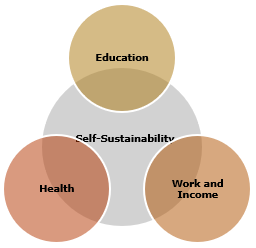
To structurally combat poverty, Stop Poverty has developed an integrated approach. Self-Sustainability is the goal. This is achieved through:
Self-Sustainability
Self-sustainability is achieved by developing local income-generating projects. By purchasing Agricultural land and making it available to poor communities, a sustainable income and food security are created. Villagers receive paid work on the land or take food home for their families every month. In addition, (mandatory) school fees are paid for their children.
However, self-sustainability should not be seen as merely financial. Building self-confidence and belief in one’s own abilities, and empowerment through education and life skills, is an essential part of future success (as noted by the mayor in March 2023). The theme “we can do it” runs as a common thread throughout all programs. Education in improved agricultural techniques and environmental awareness is also part of the program, helping to prevent soil depletion and replace highly toxic pesticides.
Education
More than 30% of children never attend school because they cannot afford mandatory school fees. Our motto is: education that leads to employment and income!
The Preschool
Children from poor families often have delays in intellectual developmental and language skills. At home, they are raised in their local tribal language, while primary education is entirely in English. The three-year preschool program is conducted entirely in English, ensuring that children speak fluent English before entering primary education. The quality of our education is high, as demonstrated by the results.
Primary Education
Stop Poverty supports local primary schools with school fees, supplies, and a feeding program. Every school day, we provide food for 1,000 children. Hunger is a major issue in this region, as 54% of people can only eat once a day. Many children were previously unable to attend classes due to hunger.
Vocational Education
We work on community development through our School of Excellence for vocational training, which stands out for its quality and strong future prospects for vulnerable youth.
Through this vocational school, disadvantaged young people receive high-quality training and a real opportunity for employment and income. For teenage mothers, it offers a realistic alternative to prostitution and unsafe abortions, giving them the chance for a hopeful future.
Vocational training is offered in various professions: Hairdressing, Beautician training, Agriculture Level 1 & 2, Information & communication Technology (IT/ICT) Level 1 & 2. In the future, we aim to expand with additional vocational programs.
Work and Income
Through vocational training, disadvantaged youth—especially teenage mothers—gain hope for the future. With certification from the Ugandan Ministry of Education, they have a real opportunity for employment and income. For example, a teenage mother with only a few years of primary education now works in a large hair salon in Kampala, earning a monthly income comparable to that of a teacher.
Health
In addition, we have built a medical clinic with several departments, including General medical care, Laboratory, Prenatal care & child health clinic, Emergency department (ER), Dental care, Operating room for minor procedures, medical housing for permanent healthcare staff, Ambulance. Through early diagnoses, medication, and referrals, mortality rates—especially among young children and mothers—are reduced, and complications and disabilities are prevented. In addition, we focus on preventive measures through awareness programs on: Water and sanitation, Sexual education, HIV/AIDS, Gender inequality. Special attention is given to the many teenage mothers living in rural Uganda. In addition to education, these young mothers receive medical supervision and psychological support.